
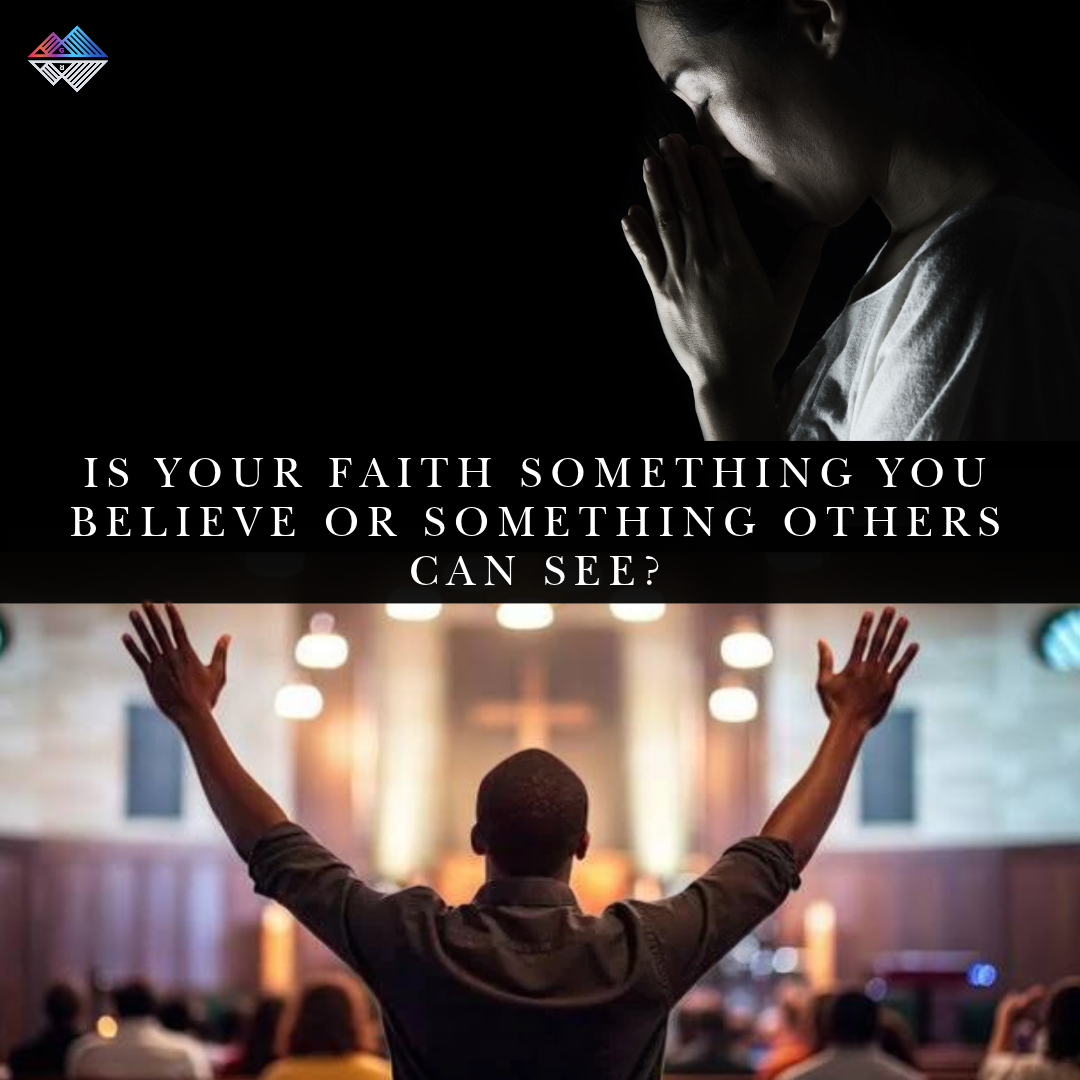
When Faith Becomes Visible: Is your faith something you believe—or something others can see? 24 24
| There is a difference between private belief and visible faith. For many years, my faith was something I carried internally. It influenced how I thought, how I processed decisions, and how I handled pressure. It was present—but not always visible. Not intentionally hidden but not fully expressed. In business, there is a natural tendency to separate the two. Faith becomes personal. Business becomes practical. Conversations become measured. Decisions become analytical. And over time, without realizing it, the integration begins to fade. I began to notice moments where that separation showed up. Conversations where I softened conviction to maintain comfort. Decisions where I relied more on logic than alignment. Situations where I knew what I believed—but chose not to fully express it. Not out of fear, but out of habit. And habit can quietly shape leadership. “Faith that remains separated from how we live can gradually lose its influence. Faith that is lived becomes foundational.” — Jerry R. Meek There were moments when the tension became clear. Decisions that required more than analysis. Conversations that required more than diplomacy. Situations where silence would have been easier—but clarity required expression. Those are defining moments because they reveal the alignment between what we say we believe and how we live. James, the brother of Jesus, wrote, “Faith by itself, if it is not accompanied by action, is dead.” In The Message, the point is even more direct: “God-talk without God-acts is outrageous nonsense.” That leaves little room for passive faith. It calls for integration. But visible faith does not mean turning every business conversation into a sermon. It does not mean quoting Scripture in every meeting or expecting everyone around us to share our beliefs. Visible faith is often much quieter than that. It shows up in how we treat people, how we handle money when no one is watching, whether we admit a mistake instead of defending it, whether we keep a commitment that has become inconvenient, and whether we tell the truth when another answer would be easier. Sometimes the clearest evidence of faith is simply consistency. I have experienced this many times in construction leadership. A project problem surfaces. The cost may be greater than expected. The schedule may be affected. The client may not like the answer. Before the conversation ever happens, there are two choices. You can soften the problem, delay the conversation, or hope another solution appears before anyone has to hear the difficult news. Or you can walk into the room prepared to tell the truth. I have learned that the second choice is almost always harder in the moment—and better in the long run. When I have had to deliver difficult news, the temptation is to focus on how the other person might react. But leadership requires a different question: What does integrity require of me right now? That means explaining what happened clearly, taking responsibility for what belongs to us, presenting the best options, answering questions honestly, and refusing to protect our comfort at the expense of someone else’s trust. The conversation may still be uncomfortable. The client may still be disappointed. The answer may still cost money and usually time. But faith becomes visible when truth matters more than avoiding discomfort. I have found that people can work through difficult news. What is much harder to repair is the feeling that someone withheld it from them. There have also been conversations where I chose to speak from conviction instead of convenience. Not forcefully, but clearly. Not to prove a point, but to remain aligned. Clarity may create disagreement. Inconsistency creates distrust. People do not have to agree with everything you believe to recognize that your life is anchored by something deeper than circumstances. When people see that you are trying to live consistently with what you believe, they know where you stand. That consistency builds credibility. “Faith is not proven by what you believe in quiet moments, it is revealed by what you live in visible ones.” — Jerry R. Meek Looking back, the shift was not dramatic. It was intentional. I began asking a different question. Instead of simply asking, What is the smartest decision? I began asking, What decision best reflects what I say I believe? Good business judgment still matters. Experience matters. Facts matter. Financial discipline matters. God has given us minds to think, evaluate, prepare, and make wise decisions. But there are moments when logic tells us what is possible while faith reminds us of what is right. That is where alignment matters. When faith becomes visible, leadership becomes anchored. And when leadership is anchored, decisions become clearer—even when they remain difficult. That does not mean we will always get it right. I haven’t. There are still moments when I recognize afterward that I could have spoken sooner, listened better, shown more courage, demonstrated more grace, or trusted God more completely. Visible faith is not a declaration of perfection. It is a commitment to keep bringing what we believe and how we live closer together. And that is where I find hope. God gives wisdom when we ask, grace when we fail, and courage when the next step feels uncomfortable. He is present in the ordinary decisions where our faith is being formed long before anyone else notices. You may look back and see a conversation you avoided, a decision you wish you had handled differently, or a time when fear spoke louder than conviction. That does not have to be the end of the story. God’s grace gives us the freedom to learn from yesterday without being trapped by it. His mercy allows us to begin again. You do not have to transform everything at once. Start with the next decision, the next conversation, the next opportunity to choose integrity over convenience, courage over silence, grace over frustration, or trust over fear. Faith becomes visible one faithful decision at a time. You may never know how much those decisions matter to the people watching your life. A team member may remember how you treated them when they made a mistake. A client may remember that you told the truth when it would have been easier not to. Your children may remember that your faith shaped how you lived—not simply what you said. Your faith does not become visible because you never struggle. It becomes visible because, in the middle of the struggle, you continue turning to God. Keep taking the next faithful step. Over time, the faith you once carried quietly inside begins to shape the life others can see. |
Keep building, keep growing, and never settle,
-Jerry.
REFLECTION
- Is my faith visible in how I lead, decide, and treat people?
- Where have I allowed belief and action to become separated?
- What would it look like for me to live my convictions more consistently?

Application Business Leadership