
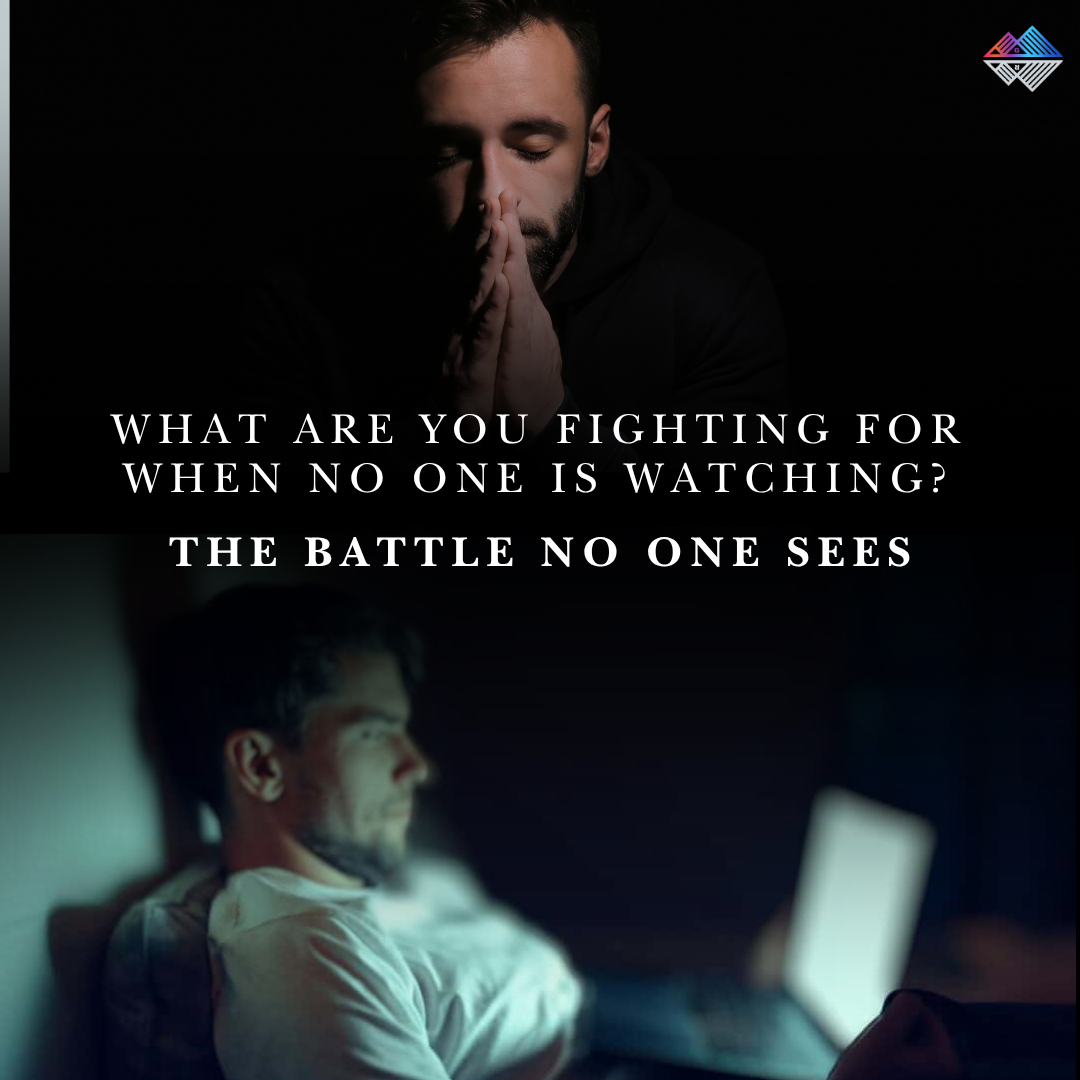
What Are You Fighting For When No One Is Watching? 23
| Some of the most important battles in life are the ones nobody else knows you are fighting. They happen when the door is closed, the phone is in your hand, the house is quiet, and no one is watching. Pornography has become one of those battles for millions of people—including Christians. Recent Barna research found that 75 percent of Christian men and 40 percent of Christian women acknowledge consuming pornography on some level. About half of pornography users say no one knows about their habit, and 84 percent say no one is helping them avoid it. Those numbers should get our attention. This is not simply a cultural problem outside the Church. It is a private battle being fought quietly in homes, marriages, churches, businesses, and leadership circles every day. The danger is that it rarely begins with someone deciding, I am going to destroy something important. It usually begins much smaller: curiosity, stress, loneliness, boredom, travel, or fatigue—something that seems private, occasional, and manageable. Then occasionally becomes familiar, familiar becomes repeated, and repeated becomes hidden. Eventually, secrecy begins protecting something you once believed you controlled. “The first sign that something is controlling you may be how hard you work to keep anyone else from seeing it.” — Jerry R. Meek People who later describe their pornography use as compulsive often say they missed the warning signs. They believed they could stop whenever they wanted, underestimated their triggers, minimized what they were doing, and convinced themselves it was not affecting anyone else. But hidden choices rarely remain isolated. The cost eventually appears somewhere else—in peace, intimacy, concentration, trust, marriage, leadership, or faith. For a leader, there can be another cost: the growing distance between the person others believe you are and the person you know you are becoming. That distance is exhausting. Secrecy requires energy. Integrity restores it. The Bible never tells us temptation will disappear. It tells us something far more useful: we do not have to surrender to it. Paul the Apostle says in 1 Corinthians 10:13 that temptation is common to humanity and that God is faithful. He provides a way of escape. But we have to take the escape. Joseph did not negotiate with temptation when Potiphar’s wife pursued him. He ran. Daniel did not wait until pressure arrived to decide what he believed. He resolved beforehand that he would not defile himself. Those examples have taught me something important: some victories are won long before the moment of temptation. Years ago, I was having lunch with a man I had worked with for a long time. Our server was a beautiful woman. We exchanged a glance as she introduced herself, and that was my last look. The man I was with kept watching her, and I was getting annoyed because we had business to discuss. Finally, I asked, “Why are you so focused on her?” He replied, “Why aren’t you? Look at her.” My response was simple: “The first look may be unavoidable. The second one is a choice. And if you keep looking, eventually it can become a problem.” That may sound simple, but I have learned that problems become harder to stop after we have given them permission to begin. Wisdom does not prove how much temptation you can handle. Wisdom is deciding early what you will not allow to take root. Establish the boundary before you need it. Know when you are vulnerable. Decide who can ask you the hard questions. Remove access when access is becoming dangerous and ask for help before the consequences become larger. “You do not prove strength by seeing how close you can stand to temptation. Sometimes strength is knowing when to run.” — Jerry R. Meek Yet this chapter cannot simply be about what we need to stop. There is a deeper question: What are you fighting for? Pornography can consume attention, intimacy, emotion, time, and energy while promising something it can never provide. So perhaps the deeper question is not only, What am I trying to stop? The better question may be, What is my life for? Your mind was made for more than images you later wish you had never seen. Your strength was made for more than protecting a secret. Your marriage and leadership were made for more than divided affection and a divided life. Your life was made for something worthy. Near the end of his life, Paul the Apostle could say that he had fought the good fight, finished the race, and kept the faith. He had endured hardship, opposition, betrayal, imprisonment, and suffering, yet he kept going because he had settled the question of what was worth fighting for. Christ was worth fighting for. That same clarity matters in this battle. You do not become stronger only by hating what is wrong. You become stronger by loving what is right more deeply. Purity is not simply about what you flee; it is also about what you pursue—integrity instead of compromise, intimacy instead of isolation, honesty instead of secrecy, freedom instead of temporary relief, and Christ instead of allowing an appetite to determine the direction of your life. And if you have stumbled, do not confuse failure with finality. Paul the Apostle reminds us that Jesus understands temptation. He understands our weakness, and because He does, He invites us to come to Him for mercy and grace. Psalm 46 gives us this assurance: “God is our refuge and strength, an ever-present help in trouble” (Psalm 46:1, NIV). God does not simply see our struggle from a distance. In Psalm 50, He invites us to call on Him: “Call on me in the day of trouble; I will deliver you, and you will honor me” (Psalm 50:15, NIV). We are not being asked to fight alone. Your struggle may be part of your story, but it does not have to become the final chapter. Tell someone. Create boundaries. Ask for accountability. Remove access if you need to. Seek professional help when the pattern has become compulsive. Do not let pride persuade you to fight alone. There is courage in admitting that you need help, courage in choosing the light, and courage in deciding that something worth keeping is worth fighting for. “Freedom often begins with one courageous decision: stop protecting what is quietly destroying you.” — Jerry R. Meek The battle may be one nobody else sees, but God sees it. And that is not merely a warning. It is also hope. He sees the struggle. He sees the failure. He sees the desire to change. And He still calls us toward freedom, integrity, and a life fully devoted to Him. The question is not whether you have ever lost a battle. The question is whether you are willing to keep fighting for the person God is calling you to become. This may be the battle nobody sees, but it may also become one of the most important battles you ever choose to win. |
Keep building, keep growing, and never settle,
-Jerry.
REFLECTION
- Is there an area of my private life that I am working harder to conceal than to change?
- Where am I most vulnerable—stress, fatigue, loneliness, travel, boredom, or isolation—and what boundaries have I established before temptation arrives?
- What am I truly fighting for, and who knows enough about my struggle to help me protect it?

Application Business Leadership