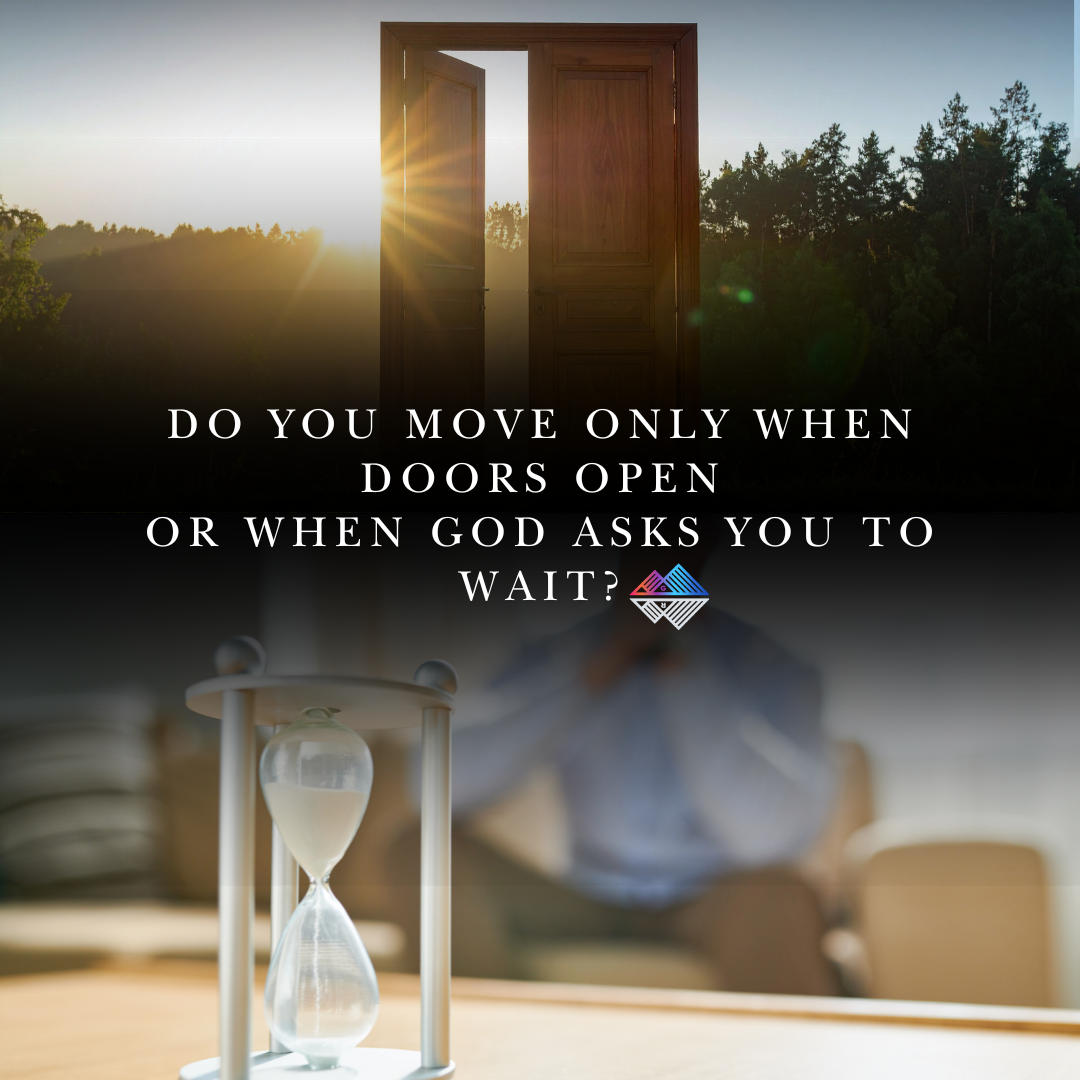
Do you move only when doors open—or when God asks you to wait? Ch. 15
| Do you move only when doors open—or when God asks you to wait? If silence tests your faith, waiting tests your obedience. It is one thing to trust God when nothing is happening; it is another to hold your position when something could be. That is where the tension becomes real. We are conditioned to move. In business, progress is measured by action—decisions made, deals closed, and projects advancing. Movement feels like leadership because it creates momentum, signals confidence, and produces visible results. Waiting, however, feels the opposite. It feels like a delay, hesitation, and a missed opportunity. It can feel like you are falling behind while others move ahead. And yet, some of the most defining moments in faith are not found in movement; they are found in restraint. There have been seasons where opportunities were clearly available. Paths were open, and decisions could have been made that would have moved things forward. From the outside, those decisions would have looked right. From a business standpoint, they made sense. But internally, something didn’t align. It wasn’t fear—it was restraint. That creates a different kind of tension. It is easier to act than it is to wait. It is easier to justify movement than it is to defend stillness, especially when others expect progress. But waiting is not inaction; it is alignment. “Obedience is not always measured by what you do—it is often revealed by what you are willing not to do.” — Jerry R. Meek There was a season early on when we weren’t winning work. We were bidding projects, putting in the effort, and doing what we believed was right—but the results weren’t there. We weren’t landing the jobs, and the pressure built quickly. You begin to question your approach, your positioning, and even your standards. The questions shift. Should we lower our price? Adjust our quality? Compete differently to win something? Because when nothing is coming in, the instinct is to move—to change something, to create traction, to force progress. And we could have. We could have lowered our expectations. We could have pursued the same work everyone else was chasing. We could have competed on price or speed. In the short term, it may have worked. But we didn’t. Instead of chasing what wasn’t working, we stepped back and waited—not passively, but intentionally. We re-evaluated the work we were pursuing and focused on where we could bring the most value, not just where we could win. We chose to pursue more complex projects that required more leadership and greater skills, more coordination, and a higher standard. It didn’t produce immediate results. For a time, it felt like we were slowing down even more. The pressure didn’t disappear, and the uncertainty didn’t fade. But beneath the surface, something more important was happening. We were repositioning. We stopped trying to win what everyone else was chasing—and waited for what aligned. Over time, that decision changed everything. The work began to come—not all at once, but in a way that matched who we were becoming. The projects were more complex, the relationships were stronger, and the expectations were higher. The foundation we were building proved far more sustainable than anything we could have forced in the moment. Looking back, that season wasn’t about losing work. It was about refusing to take the wrong work. Because waiting requires discernment. It requires the ability to distinguish between opportunity and alignment. Not every open door is meant to be walked through, and not every opportunity is meant to be pursued. King David, a warrior and leader, calls us to wait with strength and courage. Waiting requires conviction and the willingness to trust timing—not just direction. There were times when waiting felt costly. Opportunities passed, momentum slowed, and questions surfaced. What if this is the wrong decision? What if waiting creates loss? What if I miss something? Those questions don’t disappear—but neither does conviction. “Waiting will always feel like risk when measured by opportunity—but it becomes clarity when measured by alignment.” — Jerry R. Meek Looking back, the seasons where I waited were not wasted; they were protective. They kept me from moving too early, from committing to the wrong direction, and from stepping into something that looked right but wasn’t aligned. Timing is not secondary in leadership; it is foundational. God is not just concerned with where you go; He is concerned with when you go. When you understand that, waiting no longer feels like a delay; it feels like discipline. Because obedience is not always about moving forward. Sometimes it is about staying exactly where you are until the time is right. Waiting reshapes how you think about timing. It challenges your assumptions about progress and teaches you that what feels like delay may actually be protection. Beneath that is something deeper: how you handle waiting is tied to what you believe about provision, control, and trust. Because waiting is not just about timing. It is about surrender. It is about releasing the need to force outcomes and choosing instead to remain aligned. And in that space, something shifts. What once felt like hesitation becomes discipline. What once felt like a delay becomes clarity. What once felt like risk becomes trust. Because not every opportunity is meant to be pursued—and not every open door is meant to be walked through. Sometimes, the most faithful decision you can make is to stay |
Reflection
- Where am I feeling pressured to move ahead instead of waiting with intention?
- Am I defining progress by constant activity, or by being aligned with what truly matters?
- What could this season of waiting be protecting, preparing, or redirecting me from?
Keep building, keep growing, and never settle,
-Jerry.

Application Business Leadership