
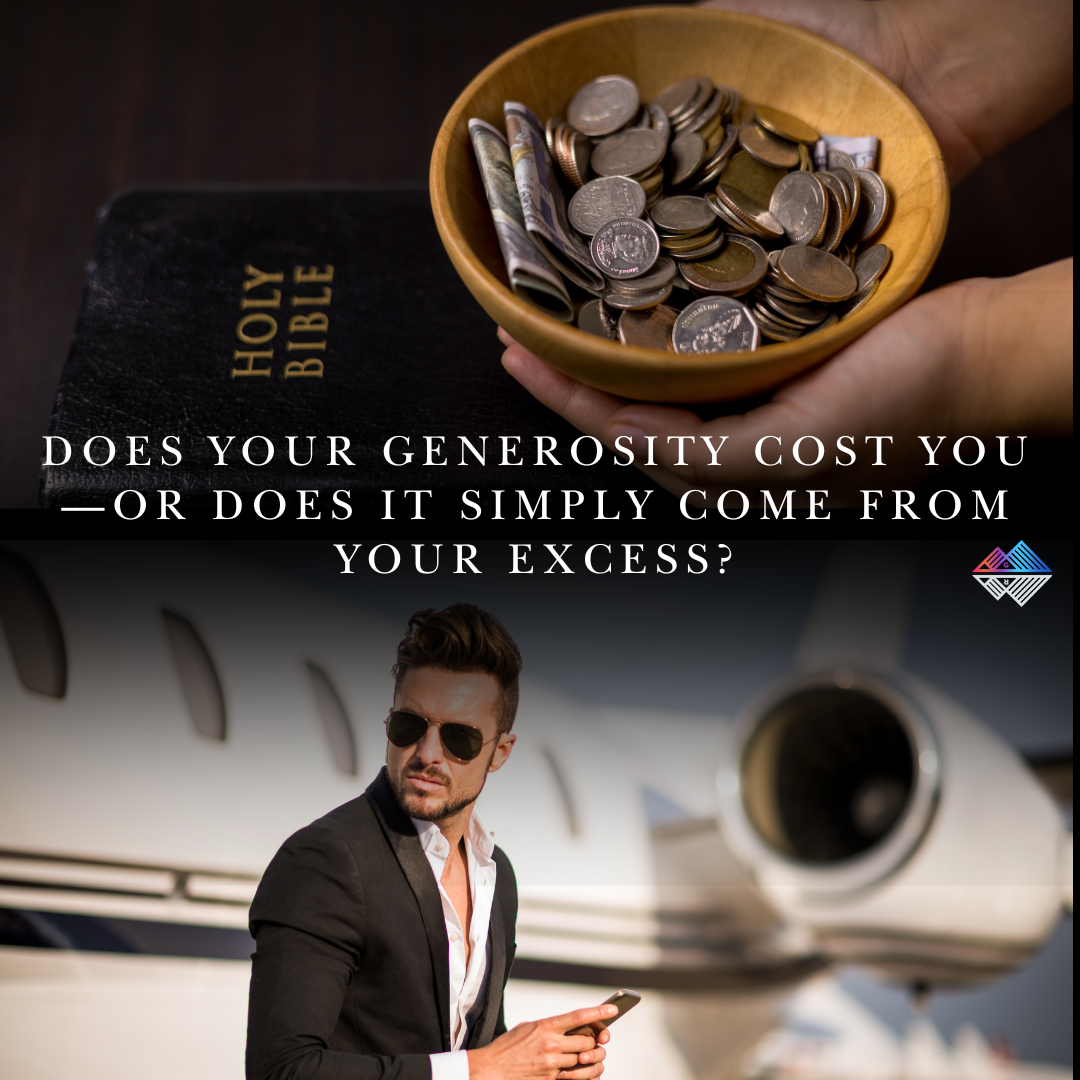
Does your generosity cost you—or does it simply come from your excess? Ch. 17
| Does your generosity cost you—or does it simply come from your excess? King David refused to offer God a sacrifice that cost him nothing: “I will not sacrifice to the LORD my God burnt offerings that cost me nothing.” Giving is easy to admire and even easier to discuss. It becomes far more challenging when the numbers are real, commitments are significant, and the timing feels less than ideal. In those moments, generosity collides with careful calculation, responsibility, and our desire to remain in control. There have been seasons when giving felt effortless and others when it felt costly. Those are the moments that matter most because generosity is not tested when it is comfortable; it is tested when it requires trust. I remember a season when Carol and I chose to give at a level that exceeded what the numbers suggested was comfortable. It wasn’t an emotional decision or an impulsive act of generosity. We carefully reviewed our cash flow, future commitments, and financial obligations. From a business perspective, waiting another year would have been the prudent decision. It would have provided greater security and stronger financial margins. Everything about the spreadsheet suggested patience. Yet something deeper than the spreadsheet was leading the decision. Faith was asking for obedience before certainty. Ultimately, conviction—not timing—led our decision. Looking back, I realized God wasn’t simply asking for a financial gift. He was asking whether we trusted Him more than we trusted our projections. Generosity has a remarkable way of exposing where our confidence truly rests. The instinct to wait often feels responsible, but it is not always rooted in faith. Sometimes it is rooted in control—the desire to ensure everything works out before we obey. Faith does not require certainty; it requires trust. Generosity is one of the clearest expressions of that trust. “Generosity is not proven by what you give when you have excess—it is revealed by what you release when it costs you something.” — Jerry R. Meek Over time, I realized giving is not only about changing someone else’s life, but also equally about changing our own. Every act of generosity confronts what you believe about provision, ownership, security, and control. Jesus addressed this directly in the Sermon on the Mount: “Do not store up for yourselves treasures on earth, where moths and vermin destroy, and where thieves break in and steal. But store up for yourselves treasures in heaven… For where your treasure is, there your heart will be also.” Eugene Peterson paraphrases this as “stockpiling treasure in heaven, where it’s safe.” That perspective changes everything. Giving is no longer loss—it becomes an eternal investment. Your focus shifts from what is leaving your hands to what is being deposited into God’s eternal kingdom. Jesus was not discouraging wise financial stewardship. He was redefining the ultimate destination of our investments. Every earthly investment eventually reaches an ending point. Markets fluctuate, businesses change, real estate ages, and possessions wear out. Yet every act of generosity offered in obedience carries eternal significance. Heaven keeps perfect records of what earth often overlooks. Every sacrifice, every unseen gift, and every quiet act of obedience matter to God. Nothing surrendered in faith is ever wasted. There were times when giving made little sense financially, yet it made complete sense spiritually. Those moments became defining moments because faith flourishes through obedience. Releasing our faith opens the channel to what God intends to do above and beyond what we can. Giving gradually became less about managing resources and more about stewarding God’s resources. Once I understood that I was a steward rather than an owner, generosity stopped feeling like loss and started feeling like worship. Everything I possess has been entrusted to me by God. Once I embraced that truth, giving was no longer a transaction or an obligation—it became an act of worship and a declaration of trust. “Closed hands protect what you have. Open hands position you for what God can do through you.” — Jerry R. Meek Looking back, the greatest impact of generosity was never what left my hands, it was what changed within my heart. Generosity loosens our grip on control, deepens our faith, and gradually conforms our hearts to the heart of Christ. It reminds us that our greatest wealth is not measured by what we accumulate, but by what we faithfully steward for God’s purposes. In the end, generosity is not measured by the size of the gift but by the depth of the trust behind it. The greatest gifts are rarely the largest; they are the ones that require faith. That is the kind of giving that shows up in heaven. Remember David’s words: “I will not sacrifice to the LORD my God burnt offerings that cost me nothing.” Genuine generosity has always carried a cost. Yet every sacrifice made in faith becomes an eternal investment, and every act of faithful obedience leaves a legacy that reaches far beyond this life. “The greatest return on generosity is rarely what God puts in your hand it is what He builds and activates in your heart.” — Jerry R. Meek Keep building, keep growing, and never settle, Jerry R. Meek |
Reflection
- Is my generosity driven by comfort—or by conviction?
- What am I holding too tightly that God may be asking me to trust Him with?
- What act of generosity could I make today that would become an investment in eternity?
Keep building, keep growing, and never settle,
-Jerry.

Application Business Leadership